4,7 / 5

 Tactical Clothing
 Tactical Gear
 Airsoft Parts & Upgrades
 Airsoft Accessories
 Magazines
 Ammunition & Gas
 Survival & Outdoor
 New Arrivals
 Outlet
Night Vision (NVG)
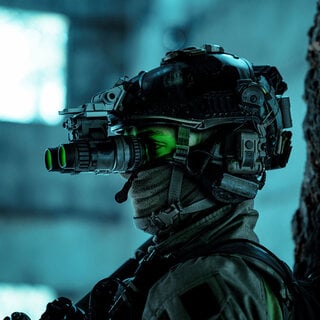
Anyone who is serious about milsim, airsoft or tactical operations will, sooner or later, end up using night vision. In practice, we find that once players have used a set of night vision goggles, they never want to go back. The difference lies not only in visibility, but also in situational awareness, reaction time and control over your surroundings.
Go straight to the information you need:
• In what situations do you use Night Vision Goggles (NVG)?
• Budget versus premium night vision
• Ergonomics and balance of NVG setups
• Visibility, contrast and detection under night vision
• Common mistakes with night vision
• Frequently asked questions about night vision
You’ll immediately notice the real difference when you use them. Budget night vision goggles often produce a grainy image, have limited light amplification and react erratically to changing light conditions. You’ll notice this straight away during intensive use, such as a weekend milsim where you’re completely reliant on your vision. Premium night vision systems from brands such as AGM Global Vision and Luna Optics, on the other hand, stand out for their image quality, reliability and consistency.
A high-end NVG unit features better image intensifier tubes, higher resolution and a more stable signal without blooming in sudden bursts of light. Premium systems perform much more consistently, particularly when moving from open terrain to the edges of woods or dark areas. That is the difference between simply seeing and actually being able to interpret what you are observing.
| Property | Getting started / Digital | Premium (Gen 2+) | High-End (Gen 3) |
|---|---|---|---|
| Image quality | More grainy, more frequent delays | Sharp, high-contrast | Extremely sharp and clear |
| Light amplification | Limited (IR lamp required) | Very strong | Maximum (requires little ambient light) |
| Sensitivity to bright light | Can 'bloom' | Good automatic adjustment | Minimal halo and blooming |
| Weight & Balance | Often heavier | Robust yet balanced | Lightweight and compact |
| Best effort | Short night-vision goggles & CQB | Weekend Milsim events & outdoor use | Professional & Committed |
In what situations do you use night vision goggles (NVG)?
You don’t just buy night vision equipment on a whim. For most users, the need for night vision only arises when night-time gameplay, milsim events or professional applications become a regular part of their activities.
- Night-time operations and low-light missions: As soon as visibility is reduced, everything changes. With night vision goggles, you retain control of your surroundings whilst others are reliant on torches or their reaction times. In urban environments with fluctuating light conditions, this provides a clear advantage in terms of positioning and timing.
- Milsim and extended night operations (48 hours+): During the night-time phases of milsim events, visibility is no longer a luxury, but a necessity. Reliability, battery life and comfort are what determine whether you remain operational. Lightweight NVGs with external battery packs and a stable mounting system ensure prolonged use without causing fatigue.
- Professional use and serious applications: In this segment, performance is key. IR detection, a low signature and compatibility with IR lasers and illuminators are essential. Gen 2+ and Gen 3 systems with high gain and low halo values deliver the standard performance in this area.
What is often underestimated is that the effectiveness of a night vision goggle (NVG) does not depend solely on the device itself. In practice, mounting, balance and helmet configuration are just as important. A high-quality NVG without a stable setup will still lead to fatigue and reduced performance.
We also find that many players and users forget that their sight or optic needs to be compatible with this. A red dot that isn’t night vision compatible (NV-compatible) can be too bright when used with NVGs or even completely “blow out”, leaving you with no usable reticle. An NV-compatible red dot, such as some models from Vortex Optics with adjustable low brightness, is therefore not a luxury, but an essential part of a properly functioning night setup.
Many standard red dot sights do not have sufficiently low brightness settings, which means that the reticle appears too bright when used with night vision, causing details in the field of view to be lost.
Budget versus Premium Night Vision
Entry-level digital models often provide an accessible introduction to night vision. As conditions become more challenging, differences emerge in image quality, response time, light amplification and reliability.
Premium Gen 2+ systems generally offer a sharper image, better contrast and more stable light amplification. The difference becomes particularly apparent during prolonged night operations and milsim events, when the ability to quickly assess the terrain and detect movement is essential.
For users who regularly take part in night-time games or professional training sessions, a high-quality NVG solution often proves to be a better investment in the long run.
Ergonomics and balance in NVG setups
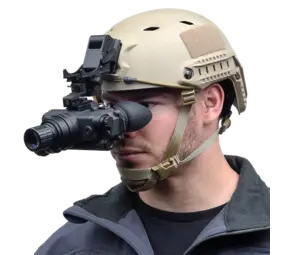
An NVG doesn’t work based on fit; rather, the ergonomics and balance of your setup determine how effective you are in the field. A poorly balanced helmet often has a greater impact on performance than minor differences in image quality.
AGM Global Vision units are robust and durable, but this often makes them slightly heavier. Without proper balance, this can quickly lead to neck and shoulder strain. Using a counterweight distributes the weight more evenly and immediately makes the system feel more stable. Luna Optics systems are generally more compact and lighter, which makes them noticeably more comfortable, particularly during longer sessions.
Common problems caused by a poor setup include:
- Neck strain after prolonged use
- Unstable image due to play or insufficient stability in the mount
- Difficulty focusing whilst moving
- Condensation caused by temperature differences
A good mount, correct adjustment of your diopter and objective lens, and a well-balanced helmet configuration make all the difference here. This is not a minor detail, but an essential part of your overall NVG setup that directly affects comfort, endurance and performance.
Visibility, contrast and detection under night vision
Whereas during the day you see colour and camouflage, things are completely different under night vision. Night vision goggles amplify light and translate it into contrast and detail, not into colour as you see it with the naked eye.
In practice, this means that visibility is determined by differences in contrast. Objects that reflect little detail can stand out as a solid expanse, whilst structures with variation actually blend in better with their surroundings. It’s less about what you’re wearing, and more about how light is reflected.
Environmental factors also play a major role. Transitions between open terrain, built-up areas and vegetation result in varying light levels. A good night vision device helps you interpret these differences, but your positioning and use of shade remain just as important.
For professional use, IR signature also plays an important role. Some materials reflect infrared light more strongly than others, meaning you can be visible under night vision goggles (NVGs) even though you are not visible to the naked eye. As a result, equipment that blends in well with its surroundings during the day can become conspicuously visible under night vision. That is why professional users often pay particular attention to IR-reducing materials and coatings. High-quality gear takes this into account, whereas cheaper materials often do not.
Common mistakes with night vision
- Choosing a NVG without considering helmet compatibility.
- Not paying attention to weight distribution.
- Using an optic that is not NV-compatible.
- Underestimating battery management during prolonged use.
- Thinking that night vision solves all visibility problems without any training or experience.
An effective night vision setup involves more than just a good pair of night vision goggles. Mounts, balance, optics and training ultimately determine how well a system actually performs.
Frequently Asked Questions about Night Vision
What is the difference between Gen 1, Gen 2 and Gen 3 night vision?
Gen 1 is entry-level with limited performance. Gen 2 offers significantly better light amplification and is suitable for serious airsoft and milsim. Gen 3 is professional-grade, offering maximum brightness, detail and reliability.
Are monocular or binocular night vision goggles better?
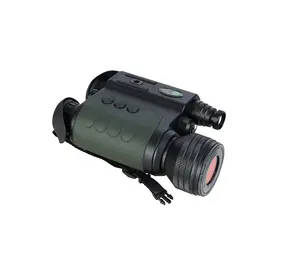
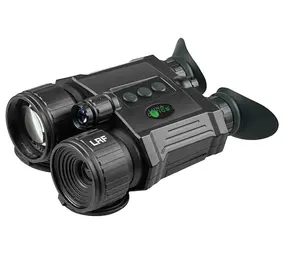
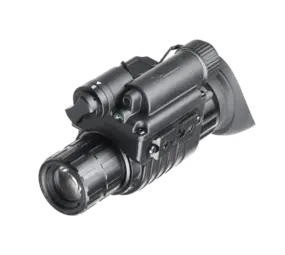
A monocular is lighter and more versatile, making it ideal for airsoft. Binocular systems offer greater depth perception but are heavier and are more commonly used by professionals.
How important is an IR illuminator?
Essential in complete darkness. Without ambient light, you need an IR source to generate an image. External IR lamps perform better than built-in versions.
Can I combine an NVG with my existing helmet?
Yes, provided your helmet has an NVG shroud and you use a compatible mount. This determines the comfort and stability of your setup.
What about battery life?
This varies depending on the model. For prolonged use, external battery packs are often necessary to ensure consistent performance.
Do I need an IR laser with a night vision goggle setup?
Not always, but many users combine night vision with an IR laser to aim more quickly without using a traditional optic. This is particularly advantageous during night-time operations.
Why do many players use a counterweight on their helmet?
A counterweight balances out the weight of the NVG at the front of the helmet. This reduces strain on the neck and makes the setup more comfortable during prolonged use.
With the right Night Vision (NVG) setup, you can take your performance to a level where visibility, control and precision come together – exactly where the difference is made in the dark.
Deliverytime
- Free shipping from €99 (NL and BE)
- Visit our shop in Capelle aan den IJssel
- Returns within 14 working days
Deliverytime
Deliverytime