4,7 / 5

 Tactical Clothing
 Tactical Gear
 Airsoft Parts & Upgrades
 Airsoft Accessories
 Magazines
 Ammunition & Gas
 Survival & Outdoor
 New Arrivals
 Outlet
Tactical & Molle Pouches
Anyone looking to buy Tactical & MOLLE Pouches will soon discover that a plate carrier, chest rig or combat belt only really comes into its own with the right configuration. After all, pouches determine how quickly you can swap magazines, how clearly your kit is organised and how efficiently you can operate during a skirmish or tactical training exercise. A well-designed loadout is therefore not about maximising storage space, but about cleverly positioning exactly the kit you need.
Go straight to the information you need:
• Molle or PALS? What exactly is the difference?
• Which Molle pouch do you need?
• Why choose modular Molle pouches?
• Why does a Molle pouch stay in place so securely?
• Materials and build quality
• Traditional Molle or laser-cut Molle?
• How do you build an efficient Molle configuration?
• Where should you position different Molle pouches?
• Frequently asked questions
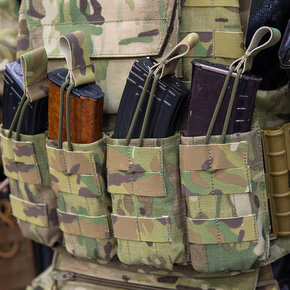
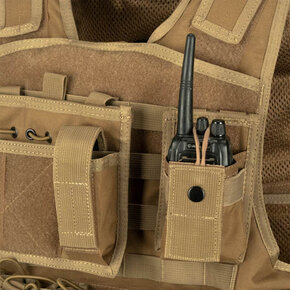
In this category, you’ll find an extensive range of modular pouches for virtually any application. From ammo pouches and dump pouches to radio pouches, medic pouches, hydration pouches and complete back panels. Thanks to the modular MOLLE system, you can tailor your kit entirely to your playing style, mission or working environment, and easily adapt it as your needs change.
MOLLE or PALS? What exactly is the difference?
The terms MOLLE and PALS are often used interchangeably, but technically speaking they do not mean the same thing. MOLLE (Modular Lightweight Load-carrying Equipment) is the complete modular carrying system used worldwide on tactical equipment. PALS (Pouch Attachment Ladder System) refers to the horizontal webbing to which pouches and accessories are attached.
In practice, people almost always refer to MOLLE pouches and MOLLE webbing. That is why we also use the term MOLLE on this page, even though the webbing is technically part of the PALS system.
| MOLLE Pouch | Role | Best use |
|---|---|---|
| Ammo Pouches | Carrying magazines | CQB, outdoor and milsim |
| Grenade Pouches | Storing grenades or smoke grenades | MilSim and tactical scenarios |
| Dump Pouches | Temporary storage of empty warehouses | Quick reloads |
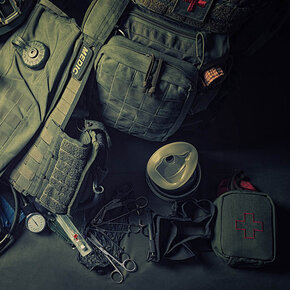
| Medic & Utility Pouches | First aid and general equipment | Every loadout |
| Radio Pouches | Communications equipment | Teamplay and milsim |
| Admin Pouches | Organising small accessories | Navigation and administration |
| Hydration Pouches | Bring your own drinking water system | Lange outdoor skirms |
| Back Panels | Extra storage at the back of the plate carrier | Team operations and long-term missions |
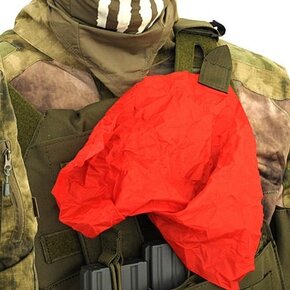
| Hit Rags | Hit marking during airsoft | Every airsoft loadout |
Which MOLLE pouch do you need?
Which pouches you need depends entirely on your playing style. Whilst a CQB player prioritises speed and freedom of movement, a milsim player will place greater value on extra storage capacity and a more extensive configuration.
- Ammo Pouches: For quick access to rifle and pistol magazines.
- Grenade Pouches: Voor smoke grenades, BB-granaten of flashbang trainers.
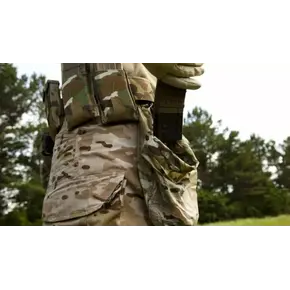
- Dump Pouches: For storing empty magazines quickly and safely whilst reloading.
- Medical & Utility Pouches: For first-aid supplies, multi-tools, batteries and other equipment.
- Radio Pouches: For two-way radios and communication equipment.
- Admin Pouches: For cards, notepads, writing materials and small accessories.
- Hydration Pouches: For a water reservoir during longer skirmishes or outdoor activities.
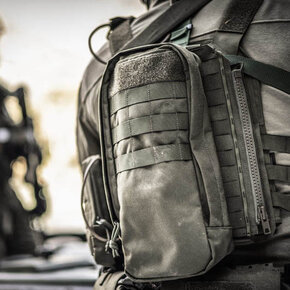
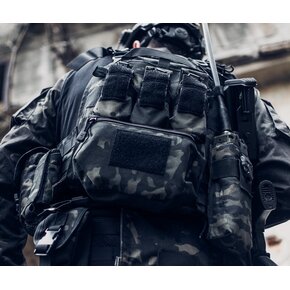
- Back Panels: For extra storage capacity on the back of a plate carrier.
- Hit Rags: For a clearly visible hit marker during airsoft matches.
An efficient loadout isn’t about having as many pouches as possible, but about having the right pouches in the right place. As players gain more experience, you often find that their set-ups actually become more compact. Unnecessary accessories are removed, leaving only the equipment that is actually needed during a mission.
In practice, you’ll find that many experienced players actually simplify their set-up over time. Whilst beginners are often tempted to make use of every available MOLLE attachment point, experienced players usually opt only for the pouches that are actually used during a skirmish. This results in a lighter, more organised and more efficient loadout.
When choosing MOLLE pouches, bear in mind the following, amongst other things:
- The purpose of the pouch in your loadout.
- Compatibility with standard MOLLE/PALS webbing.
- Open or closed warehouse retention.
- Traditional MOLLE or Laser-Cut MOLLE.
- Material, construction and any IRR properties.
Why choose modular MOLLE pouches?
The main advantage of a modular system is that you can tailor your kit entirely to any situation. A CQB setup requires a different configuration to a multi-day milsim or an outdoor skirmish. Thanks to MOLLE, you can attach pouches exactly where you can reach them most quickly and adjust your setup at any time.
As virtually every modern plate carrier, chest rig, combat belt and tactical vest uses MOLLE/PALS webbing, the scope for customisation remains vast. You’re not restricted to a single fixed configuration and can easily expand your kit as your playing style changes.
Why does a MOLLE pouch stay in place so securely?
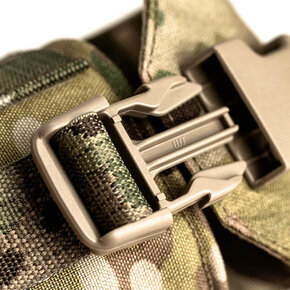
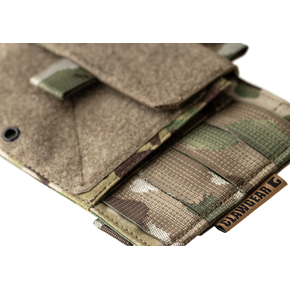
The MOLLE/PALS system was developed to secure pouches firmly to a carrying platform without them slipping out of place whilst on the move. By weaving the fastening strap alternately through the webbing of the pouch and that of the carrying platform, a particularly stable connection is created.
This ensures that magazine pouches, radio pouches and other accessories remain securely in place, even whilst running, crawling or negotiating obstacles. A correctly attached MOLLE pouch barely moves at all, making it a reliable foundation for any tactical kit.
Materials and build quality
The durability of a MOLLE pouch is largely determined by the material used, the quality of the stitching and the construction of the attachment system. Polyester is an excellent choice for recreational use, whilst Cordura® and Mil-Spec materials are better able to withstand heavy use, abrasive surfaces and prolonged professional use.
| Merk | Segment | Materials | Suitable for |
|---|---|---|---|
| 101Inc. | Budget / Entry | Polyester / Nylon | Beginners and recreational use |
| Invader Gear | Mid-range | High-quality polyester | Regular skirmishes and outdoor activities |
| Helikon-Tex | High-end | Cordura® / selected models with IRR | Keen players and the great outdoors |
| Clawgear | Premium | 500D Cordura® / selected models with IRR | Intense skirmishes and realistic loadouts |
| Templar's Gear | Premium | Laser-cut Cordura® laminate | Lightweight modular configurations |
| Warrior Assault Systems | High-end | Mil-Spec 500D Cordura® with IRR (selected models) | Professional tactical use and milsim |
| Tasmanian Tiger | High-end | Cordura® / T-Square Rip FD | Professional use and outdoor use |
In addition, an increasing number of premium pouches are now utilising Laser Cut MOLLE and IRR (Infrared Reflective Reduction). Laser Cut reduces weight and creates a sleeker profile, whilst IRR materials limit infrared reflection and are therefore better suited to professional military specifications.
Cordura® is also known for its high abrasion resistance and dimensional stability, whilst high-quality nylon laminates help to reduce the weight without noticeably compromising the pouch’s strength.
Traditional MOLLE or Laser-Cut MOLLE?
More and more tactical gear is using Laser Cut MOLLE, but that does not automatically mean it is the best choice for every user. Both traditional MOLLE and Laser Cut have their own advantages.
| Property | Traditional MOLLE | Laser-Cut SPRINGS |
|---|---|---|
| Weight | A little higher | Warehouse |
| Profile | Slightly thicker | Slimmer |
| Scalability | Excellent | Excellent |
| Wear resistance | Very high | Very high |
| Modern look | Goed | Very good |
Traditional MOLLE uses sewn-on webbing and is known for its robust construction and wide compatibility with virtually all tactical accessories. Laser-cut MOLLE is cut directly from the material, resulting in a sleeker and lighter design without compromising on expansion options. Players seeking a compact and modern loadout, in particular, are increasingly opting for laser-cut equipment.
How do you put together an efficient MOLLE setup?
A common mistake is to fill every available MOLLE slot to capacity. Whilst this may look impressive, an overloaded configuration often results in extra weight, reduced freedom of movement and slower access to essential equipment.
Experienced players therefore usually put together their loadout in a set order:
- First, the basic equipment, such as rifle magazines.
- Next, secondary equipment, such as pistol magazines.
- Next, medical equipment that needs to be readily accessible.
- Next, communications equipment and navigation.
- Finally, extra pay for specific missions or personal preference.
By only taking equipment that you actually use, your loadout remains organised, comfortable and more efficient whilst playing.
Where do you attach the various MOLLE pouches?
The position of a pouch is just as important as the choice of pouch itself. A logical layout ensures that you can instinctively reach the right equipment without making any unnecessary movements.
| MOLLE Pouch | Best position | Why |
|---|---|---|
| Ammo Pouches | Front of the plate carrier or chest rig | Fast reloads and instant access |
| Pistol Mag Pouch | Combat belt or alongside rifle magazines | Quick transition to the sidearm |
| Radio Pouch | Side of the plate carrier | Easily accessible without getting in the way of other equipment |
| Medic / IFAK Pouch | Back of the combat belt or side of the carrier | Available to yourself and your teammates |
| Dump Pouch | Behind the hip | Storing empty pallets quickly without restricting freedom of movement |
| Admin Pouch | Top of the plate carrier | Storing small accessories and documents in an organised way |
| Hydration Pouches | Back of the plate carrier | Good weight distribution and easy routing of the drinking tube |
| Back Panels | Back of the plate carrier | Additional storage for longer missions or team support |
| Hit Rags | Shoulder, back or side | Clearly visible after being hit during an airsoft game |
Although personal preference always plays a part, this classification provides an excellent basis for many players to build an efficient and well-organised loadout.
Common mistakes when choosing MOLLE pouches
- Attaching more pouches than are actually needed during a skirmish – It’s tempting to make use of every available MOLLE slot, but an overloaded kit adds extra weight and makes important accessories harder to reach. Many experienced players only take the pouches that will actually be used during a game day or milsim event, ensuring their loadout remains organised and efficient.
- Placing heavy utility pouches in illogical positions, causing the weight distribution to become unbalanced – Large utility pouches, fully loaded medical kits or other heavier accessories can affect the balance of a plate carrier, chest rig or combat belt. Distributing the weight evenly across the kit ensures the configuration remains more stable and noticeably improves comfort during longer skirmishes.
- Using open magazine pouches when extra retention is required – Open magazine pouches offer quick access to magazines, but are not the best choice in every situation. During high-intensity movement, obstacle runs or longer milsim events, a pouch with elastic retention or a closable flap can offer extra security. You should therefore choose the type of magazine pouch that suits your playing style and the conditions in which you play.
- Failing to take into account the accessibility of medical equipment – An IFAK or medical pouch is only of value if it can be accessed quickly. You should therefore place medical equipment in a logical position that is easily accessible both to yourself and – where applicable – to a team-mate during an emergency or training scenario.
- Failure to route communication cables and hydration hoses neatly – Loose cables and hoses can get caught on vegetation, vehicles or other obstacles, and can also cause unnecessary distraction. With MOLLE Multiclips, Hook & Loop Straps or other cable management solutions, your equipment stays organised and essential components are always easily accessible.
- Randomly combining different pouch systems without thinking through the overall configuration beforehand – An effective loadout isn’t achieved by attaching as many pouches as possible, but by thinking through the function of each pouch and their relative positioning beforehand. When magazine pouches, utility pouches, radio pouches and medical equipment are arranged logically, the result is a configuration that is faster to use, more comfortable to wear and better suited to your playing style.
A well-organised loadout is not about maximum storage capacity, but about speed, clarity and efficiency. Every pouch must have a clear purpose and be positioned logically in relation to the rest of the kit.
Frequently Asked Questions
What is a MOLLE pouch?
A MOLLE pouch is a modular storage pouch that is securely attached to a plate carrier, chest rig, combat belt, tactical vest or rucksack using the MOLLE/PALS system.
What is the difference between MOLLE and PALS?
MOLLE is the complete modular carrying system, whilst PALS refers to the horizontal webbing to which pouches are attached. In practice, the two terms are often used interchangeably.
Do all MOLLE pouches fit on every plate carrier?
Yes. Virtually all modern plate carriers, chest rigs, tactical vests and combat belts use the universal MOLLE/PALS system, which means that most pouches are compatible with one another.
What is the difference between an open and a closed ammo pouch?
Open ammo pouches offer the quickest access to magazines and are popular during CQB. Closed magazine pouches provide better protection for their contents against dirt, rain and loss during intense movement.
Where do you attach a dump pouch?
A dump pouch is usually attached to a combat belt behind the hip. This allows empty magazines to be stowed away quickly without restricting freedom of movement.
What is the difference between a utility pouch and an admin pouch?
A utility pouch is intended for general equipment such as multi-tools, batteries or gloves. An admin pouch is more compact and designed for small accessories, notepads, maps and writing materials.
Are laser-cut MOLLE pouches just as strong as traditional MOLLE?
Yes. High-quality laser-cut systems offer comparable strength and expandability to traditional MOLLE, whilst often being lighter and having a slimmer profile.
What does IRR mean in relation to a MOLLE pouch?
IRR stands for Infrared Reflective Reduction. The material has been treated to reduce infrared reflection, ensuring the equipment better meets military specifications for use with night-vision equipment.
Which MOLLE pouches do I need as a beginner?
For most beginners, a few ammo pouches, a dump pouch and, if necessary, a utility pouch are sufficient. As you gain more experience, you can expand your loadout with, for example, a radio pouch, a medic pouch or a hydration pouch.
With the right Tactical & MOLLE Pouches, you can build a loadout that perfectly suits your playing style and kit. Ultimately, the best loadout isn’t the one with the most pouches, but the one where every pouch has a clear purpose and is positioned exactly where you need it whilst playing.