4,7 / 5

 Tactical Clothing
 Tactical Gear
 Airsoft Parts & Upgrades
 Airsoft Accessories
 Magazines
 Ammunition & Gas
 Survival & Outdoor
 New Arrivals
 Outlet
Back-Up Sights
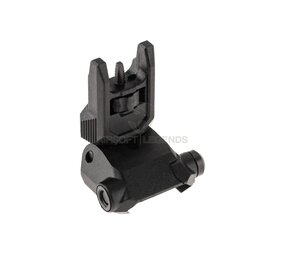
Back-up sights are often only taken seriously when your primary optic fails. A flat battery in your red dot or a fogged-up scope during a rainy skirmish can immediately limit your performance. At that moment, you want to be able to switch over without a second thought. That’s where high-quality backup iron sights, also known as BUIS, make all the difference. Better models from brands such as Magpul and IMI Defence stay more precisely aligned, have less play and are more reliable than entry-level variants.
Go straight to the information you need:
• Which backup sights suit your playing style?
• Budget versus premium backup sights
• Adjustment and ease of use
• Colour and finish
• What should you look out for when buying backup sights?
• Common mistakes when choosing backup sights
• Frequently asked questions
Cheaper sights are more likely to lose their zero or become loose on the rail over time. This has a direct impact on your accuracy, particularly during moments of rapid target acquisition. Our range includes backup sights designed specifically for airsoft use, from compact flip-up models to robust variants for intensive outdoor use.
Many players view backup sights as a stopgap solution, whereas in reality they are a standard feature of many professional and military setups. Even when an optic is fully functional, backup sights provide extra peace of mind during long outdoor skirmishes, milsim events and training sessions where reliability is paramount.
Which backup sights suit your playing style?
The right choice depends on your playing style and level of commitment. For most players, flip-up sights offer the best balance between reliability, flexibility and compatibility with modern optics:
| Usage scenario | Type Sight | Key Benefit | Material Advice |
|---|---|---|---|
| CQB | Low-profile Flip-up | Compact & does not obstruct the red dot | Polymer (Lightweight) |
| Outdoor | Adjustable Rear Sight | Remote monitoring | Metal or Hybrid |
| Milsim | Locking BUIS | Maximum reliability | Metal (Heavy-duty) |
| Scoping / DMR | 45° Angled Sights | Quick changes next to your scope | Metaal (Zero retention) |
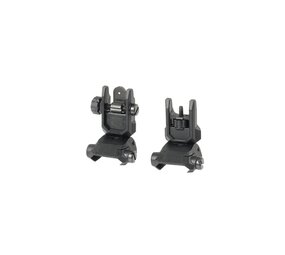
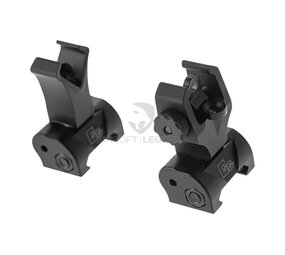
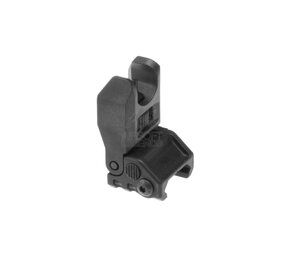
When making your choice, don’t just consider the price, but focus above all on the construction and ease of use. Polymer models, such as those from DLG Tactical or FMA, are lightweight and surprisingly strong, whilst variants such as the Magpul MBUS use more metal parts for added sturdiness. You’ll really notice this difference during intensive use and when folding the stock in and out frequently.
Always combine backup sights with a good primary optic, such as a red dot sight or rifle scope, to ensure your setup remains complete and reliable.
Budget versus Premium Back-Up Sights
Entry-level models are an excellent choice for recreational use and for shooters looking for a simple backup for their scope. As backup sights are used more frequently, differences become apparent in terms of material strength, locking mechanisms, adjustment options and zero retention.
Premium models are characterised by tighter tolerances, less play and a more reliable construction. Particularly when folded and unfolded frequently, during transport and with prolonged use, high-quality BUIS models retain their alignment better than cheaper alternatives.
For players who regularly take part in milsim events or intense outdoor skirmishes, a high-quality set of backup sights often proves to be a more worthwhile investment.
Adjustment and ease of use
Ease of use has a direct impact on speed and effectiveness. Sights with an aperture that is too small or unclear markings slow down your target acquisition, especially in fast-paced CQB situations.
Brands such as Magpul are known for their clear apertures and intuitive operation. DLG Tactical offers similar performance with a more robust build, whilst budget brands feel less refined.
The height of your sights is also important. Absolute co-witness and lower 1/3 co-witness determine how your backup sights work in conjunction with your optic. With absolute co-witness, the aiming point of the optic and the iron sights coincide exactly in the centre of the field of view. With a lower 1/3 configuration, the backup sights remain lower in the field of view, making the field of view appear calmer and reducing the distraction caused by the sights to the red dot. Players who use red dots for extended periods often prefer a lower 1/3 setup because of the improved overview, whilst still being able to switch back to their iron sights immediately when necessary.
In addition, many backup sights are adjustable. By correctly adjusting for windage and, in some cases, elevation, you can accurately zero your sights. This ensures that your point of aim matches your point of impact and prevents deviations during use.
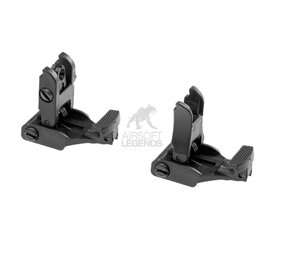
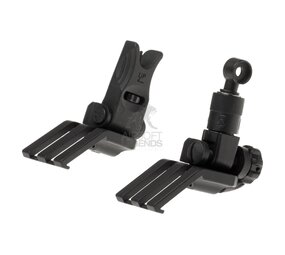
Angled sights are becoming increasingly popular for specific setups. These are mounted at an angle on your rail, allowing you to switch directly to your backup sights with a slight tilt of your replica. This is particularly effective when used with scopes or magnified optics, where speed remains crucial at close range. DMR users in particular benefit from this as they do not need to switch between magnifications or settings. A slight tilt of the replica is often enough to switch instantly to a quick aiming solution at close range.
Colour and finish
Colour plays a less significant role than with clothing, but it does have an impact on your setup:
- Black: neutral and suitable for almost any replica
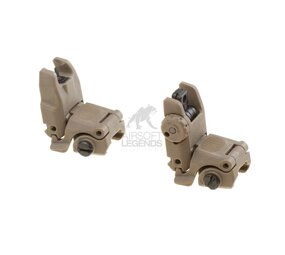
- Dark Earth (FDE): less conspicuous in light or dry environments and better suited to outdoor setups
More important than colour is the finish. Matt finishes reduce glare and are more resistant to heavy use. In bright environments, an all-black setup can actually provide greater contrast, whilst a coordinated colour scheme creates a more consistent look.
What should you look out for when buying backup sights?
When choosing backup sights, it’s not just about price or appearance, but above all about reliability and how well they fit your setup. The construction is the key factor here. Polymer models are lightweight and suitable for most players, whilst metal versions are better suited to heavy use and harsh conditions.
The type of sight also plays a role. Flip-up models are ideal for use with optics because they are only visible when needed, whereas fixed sights are always available but can affect your field of view. The right choice depends on your preference and the available rail space.
Adjustability is essential for consistent performance. Sights with clear windage and elevation adjustments allow you to zero in your setup accurately, ensuring you can still aim reliably even without an optic.
Finally, compatibility with your existing setup is important. Consider the correct height in combination with your optics and the potential use of angled sights when using scopes or magnifiers. A well-balanced combination ensures speed, control and a clear field of view in any situation.
Common mistakes when choosing backup sights
- Buying backup sights without taking the height of the scope into account.
- Opting for the cheapest option when reliability is actually the most important factor.
- Do not pay attention to co-witness configurations.
- Fitting backup sights without zeroing them correctly.
- Using fixed sights when rail space is limited.
The best backup sights aren’t necessarily the most expensive ones, but those that are best suited to your replica, optic and playing style.
Frequently Asked Questions
What exactly are backup sights?
Backup sights are mechanical aiming devices that you use when your primary optic fails. They operate without batteries and provide an immediate fallback.
Do I need backup sights with a red dot?
Yes. Electronics can fail, and when that happens, you want to be able to switch over immediately without any delay.
Which is better, flip-up or fixed sights?
Flip-up sights offer flexibility and a clearer field of view when using optics. Fixed sights are always available, but can restrict your view depending on your setup.
Do budget backup sights stay properly aligned?
Cheaper models tend to lose their zero or come loose more quickly. For intensive use, high-quality brands are recommended.
Do I need to zero my backup sights if I’m using a red dot sight?
Yes. Backup sights should always be adjusted separately so that they are ready for use immediately should the optic fail.
Which is better for airsoft: polymer or metal backup sights?
For most players, high-quality polymer offers sufficient strength and is lighter in weight. Metal models are particularly suitable for intensive use, milsim events and players looking for maximum durability.
With the Back-Up Sights, you’re choosing a reliable addition to your setup, ensuring you always maintain control and precision, even if your optic fails.

- Free shipping from €99 (NL and BE)
- Visit our shop in Capelle aan den IJssel
- Returns within 14 working days